Showing posts with label Open Culture. Show all posts
Bruce Hornsby Discusses His Adventurous Compositions and Collaborations on Nakedly Examined Music

Bruce Hornsby Discusses His Adventurous Compositions and Collaborations on Nakedly Examined Music

Bruce Hornsby is best known for his first album The Way It Is (1986), but has come light years since then through 18+ albums, experimenting with different styles, playing over 100 shows with the Grateful Dead, and scoring numerous projects for Spike Lee. He’s won three Grammys and recorded with music royalty including Elton John, Ornette Coleman, Branford Marsalis, Willie Nelson, Bob Dylan, etc.

On this episode of Nakedly Examined Music, host Mark Linsenmayer and Bruce discuss “Sidelines” (feat. Ezra Koenig from Vampire Weekend) from ‘Flicted (2022), “My Resolve” (feat. James Mercer of The Shins) from Non-Secure Connection (2020), and a new live version of “Shadow Hand” from the 25th Anniversary Edition of Spirit Trail. End song: “Cast-Off” (feat. Justin Vernon of Bon Iver) from Absolute Zero (2019). Intro: “The Way It Is” (Live from Köln, 2019). Learn more at brucehornsby.com and bruuuce.com.

Here, of course, is the original “The Way It is.” Listen to the 2019 NYC Epicenters version in full. My favorite single from that first album was “Every Little Kiss.” An early tune recently featured prominently in the second season of the TV show The Bear is “The Show Goes On.”  You may or may not recall that Bruce co-wrote Don Henley’s hit “The End of the Innocence”; watch Bruce play that live with several jazz greats. Hear the original 1998 version of “Shadow Hand.” Bruce’s 2004 “Halcyon Days” features both Sting and Eric Clapton.

The track that Bruce co-wrote for Bon Iver’s album is “U (Man Like).” Watch the video for “Days Ahead,” another single from Bruce’s newest album ‘FlictedHere’s the video for “Sidelines.” Watch a lyric video for “Cast-Off.” Watch Bruce and James Mercer performing “My Resolve” over the Internet during the pandemic.

Watch Bruce play piano with The Grateful Dead in 1991. Listen to Other Ones (Grateful Dead after Jerry Garcia’s death) play a classic Hornsby tune, “White-Wheeled Limousine,” live in 1998. His own version of that (from 1995’s Hot House), featured Pat Metheny and Béla Fleck. Watch him live in 2012 with Bob Weir and Branford Marsalis playing his tune “Standing on the Moon.”

Listen to Bruce on The Art of Longevity podcastHere he is on Sodajerker. Bruce’s appearance on Ezra Koenig’s Time Crisis podcast is on #126, and you may be able to hear it with an Apple Music subscription.

Photo by Kat Fisher.

Nakedly Examined Music is a podcast hosted by Mark Linsenmayer, who also hosts The Partially Examined Life Philosophy Podcast, Pretty Much Pop: A Culture Podcast, and Philosophy vs. Improv. He releases music under the name Mark Lint.


The Golden Age of Japanese Cinema: Kurosawa, Ozu, Mizoguchi & Beyond

?si=k7NS-uM-GjVkL0dP

Oliver Hermanus’ latest film Living transplants the story of Akira Kurosawa’s Ikiru to postwar London. Apart from its own considerable merits, it has given viewers across the world reason to revisit the 1952 original, a standout work even in a golden decade of Japanese cinema — the decade The Cinema Cartography co-creator Lewis Bond (previously featured here for other explorations of Japanese cinema and animation) explains in the video above. In the nineteen-fifties, “concentrated within a single country were some of the greatest filmmakers to ever live, simultaneously producing their greatest works. The result was a complete decentralization of classic cinema as the world was exposed to its new troupe of masters.”

After World War II, the Japanese people were “left with the reality that they were an ethnically homogeneous and culturally unified unit that did not fit in with the new, democratic world.” The American military occupation “took control of the entire Japanese film industry from 1945 until 1952,” forcibly removing any image, theme, or line of dialogue thought liable stoke recidivist popular sentiment. With not just war movies but “feudal” period pieces off the table, the only viable genre was what scholars have since labeled shomingeki, the realistic cinema of common people in ordinary situations. Even there, the censors had their scissors out: on their orders, Masahiro Makino had to eliminate a shot of the potentially nationalist symbol of Mount Fuji; Yasujirō Ozu had to cut a line from Late Spring about Tokyo being full of bomb sites.

These rules loosened toward the end of the occupation. By 1951, Kurosawa could make a daring historical picture like Rashomon, and even have it (without his consent) go on to screen at the Venice Film Festival and win a Golden Lion, then an Academy Award. The West had acquired a taste for Japanese movies, and the Japanese film industry was only too happy to cater to it. The country’s five major studios “hired the best artists of the time and gave them the financial backing and creative freedom that they needed. The result was that the studios made a lot of money, the filmmakers created an abundance of masterpieces, and the golden age of Japanese cinema meant that people filled the theaters.”

The nineteen-fifties brought worldwide acclaim to a Mount Rushmore of Japanese auteurs. Kurosawa, who revived the samurai film, “did for cinema as a whole was what most filmmakers hope, at some point, to do”: bridging “the gap between one’s artistry and mainstream appeal.” Ugetsu director Kenji Mizoguchi looked on all reality — and especially women — with a transcendental gaze. “Although not as grandiose as Kurosawa, nor as spiritual as Mizoguchi, Ozu epitomizes a sentimentality that, perhaps, has not been as well achieved by any other filmmaker to this day.” Mikio Naruse, Masaki Kobayashi, Teinosuke Kinugasa, Hiroshi Inagaki: one could enjoy a rich cinematic life with only the works of Japanese filmmakers of the fifties. It shows us “the pinnacle of what cinema can achieve, and the standard we should continue to strive for,” as Bond’s puts it in his closing line, speaking over a shot from Ikiru.

Related content:

Essential Japanese Cinema: A Journey Through 50 of Japan’s Beautiful, Often Bizarre Films

How Did Akira Kurosawa Make Such Powerful & Enduring Films? A Wealth of Video Essays Break Down His Cinematic Genius

The Aesthetic of Anime: A New Video Essay Explores a Rich Tradition of Japanese Animation

How One Simple Cut Reveals the Cinematic Genius of Yasujirō Ozu

A Page of Madness: The Lost, Avant Garde Masterpiece from Early Japanese Cinema (1926)

Wes Anderson & Yasujirō Ozu: New Video Essay Reveals the Unexpected Parallels Between Two Great Filmmakers

Based in Seoul, Colin Marshall writes and broadcasts on cities, language, and culture. His projects include the Substack newsletter Books on Cities, the book The Stateless City: a Walk through 21st-Century Los Angeles and the video series The City in Cinema. Follow him on Twitter at @colinmarshall or on Facebook.


A Fan-Made Film Reconstructs an Entire Tom Waits Concert from His “Glitter and Doom Tour” (2008)

Everybody who’s been to a Tom Waits concert has stories to tell about it — no few of them heard straight from the mouth of Waits himself. The official live album for his 2008 Glitter and Doom tour actually devotes its entire second disc to “a selection of the comic bromides, strange musings, and unusual facts that Tom traditionally shares with his audience during the piano set,” with topics ranging from “the ritual of insects to the last dying breath of Henry Ford.” This after a first disc crafted from musical performances recorded in ten different cities, “from Paris to Birmingham; Tulsa to Milan; and Atlanta to Dublin.”

“Tom Waits — Glitter and Doom Concert Experience,” the fan video above, pulls off a similar feat of assemblage, but with a visual component as well. Its creator describes it as “a compilation of professional footage and fan films,” using “all the released soundboard audio that had footage to accompany it to make a concert film that should make a good experience of what it would have been like being in the audience.”

The resulting hour-and-three-quarters includes a few examples of Waits’ onstage oratory, and more importantly, such beloved numbers from his songbook as “Goin’ Out West,” Chocolate Jesus,” “Hold On”, and “Innocent When You Dream” — each one as much of a narrative of deepest, darkest Americana as his non-musical monologues.

“A trip through the world of Tom Waits can be disorienting,” writes NPR’s Robin Hilton (alongside a streamable recording of Waits’ July 5, 2008 show at Atlanta’s Fox Theater). “His ramshackle story-songs, with their creaky instrumentation and dusty poetry, usually leave listeners with more questions than answers, and his persona outside of his music revolves around a playful but guarded mix of fiction and reality.” To promote the Glitter and Doom tour, out came “a taped press conference, featuring Waits seated at a table of microphones, answering questions amid bursts of flashbulbs and murmurs” — all of which was soon revealed not to be what it seemed. But as Waits’ strangely captivating career demonstrates, the ambiguity between performance and reality is where it’s at.

via MetaFilter

Related content:

Stream All of Tom Waits’ Music in a 24 Hour Playlist: The Complete Discography

An Animated Tom Waits Talks About Laughing at Funerals & the Moles Under Stonehenge (1988)

Tom Waits’ Many Appearances on David Letterman, From 1983 to 2015

The Black Rider: A Theatrical Production by Tom Waits, William S. Burroughs & Robert Wilson (1990)

Tom Waits Reads Charles Bukowski

The Tom Waits Map: A Mapping of Every Place Waits Has Sung About, From L.A. to Africa’s Jungles

Based in Seoul, Colin Marshall writes and broadcasts on cities, language, and culture. His projects include the Substack newsletter Books on Cities, the book The Stateless City: a Walk through 21st-Century Los Angeles and the video series The City in Cinema. Follow him on Twitter at @colinmarshall or on Facebook.


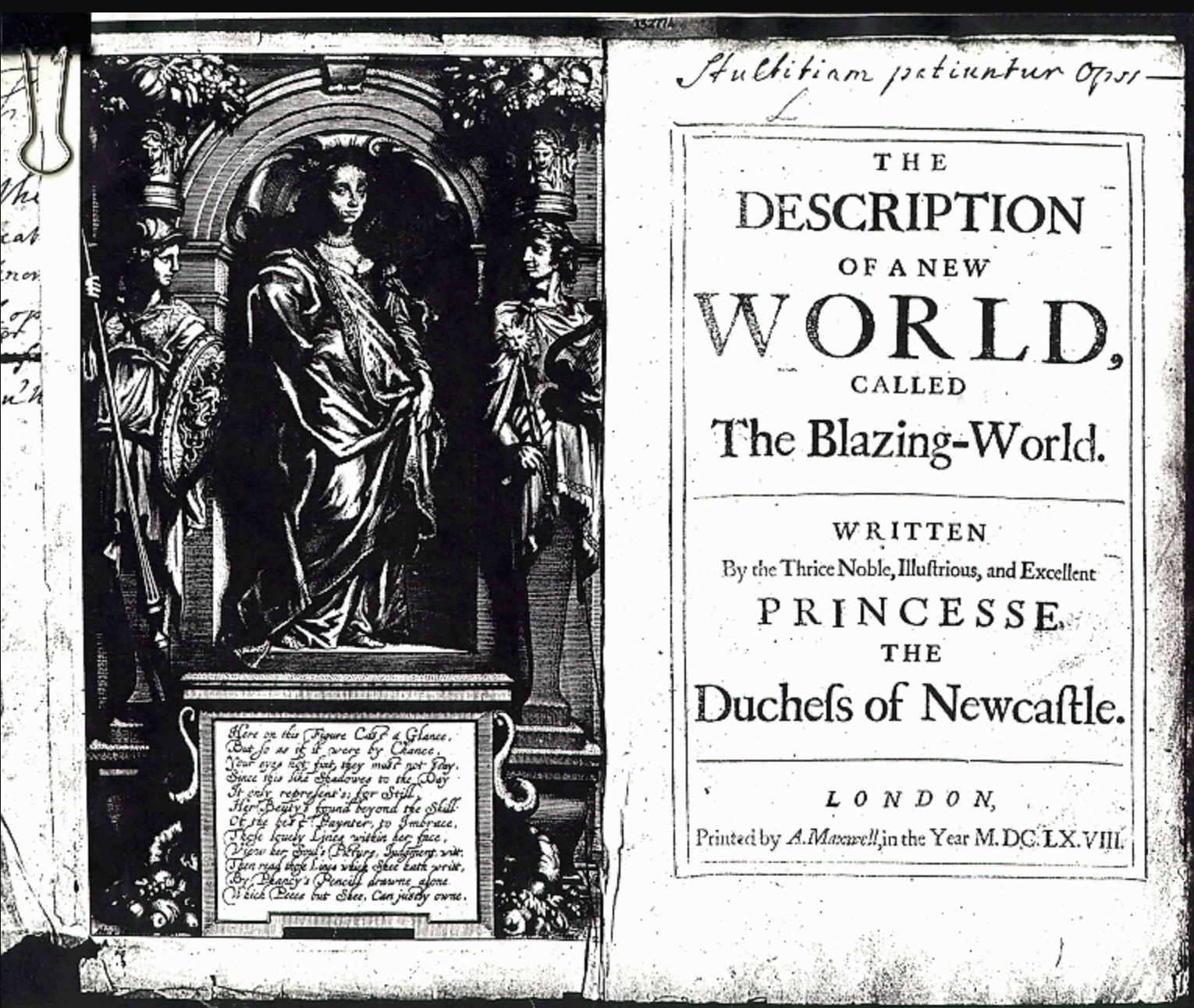
Read Margaret Cavendish’s The Blazing World: The First Sci-Fi Novel Written By a Woman (1666)

For a variety of reasons, science fiction has long been regarded as a mostly male-oriented realm of literature. This is evidenced, in part, by the eagerness to celebrate particular works of sci-fi written by women, like Ursula K. LeGuin’s Earthsea saga, Octavia Butler’s Parable novels, Joanna Russ’ The Female Man, or Margaret Attwood’s The Handmaid’s Tale (uneasily though it fits within the boundaries of the genre). But those who prefer the early stuff can go all the way back to the mid-seventeenth century, where they’ll find Margaret Cavendish’s The Blazing World, readable and downloadable in all its strange glory free online.

The Blazing World was first published in 1666 and is often considered a forerunner to both science fiction and the utopian novel genres,” writes book blogger Eric Karl Anderson. “It’s a totally bonkers story of a woman who is stolen away to the North Pole only to find herself in a strange bejeweled kingdom of which she becomes the supreme Empress. Here she consults with many different animal/insect people about philosophical, religious and scientific ideas. The second half of the book pulls off a meta-fictional trick where Cavendish (as the Duchess of Newcastle) enters the story herself to become the Empress’ scribe and close companion.”

In the video just below, Youtuber Great Books Prof frames this as not just a work of proto-science fiction, but also a pioneering use of the “multiverse” concept that has undergirded any number of twenty-first-century blockbusters.

The Blazing World continues to inspire: actor-director Carlson Young put out a loose cinematic adaptation just a few years ago. Cavendish herself described the book as a “hermaphroditic text,” possibly in reference to its engagement with topics then addressed almost exclusively by men. But it also occupied two categories at once in that she originally published it as a fictional section of her book Observations upon Experimental Philosophy, one of six philosophical volumes she wrote. In fact, her work qualified her as not just philosopher and novelist, but also scientist, poet, playwright, and even biographer. That last she accomplished by writing The Life of the Thrice Noble, High and Puissant Prince William Cavendish, who happened to be her husband. Let her life be a lesson to those young girls who simultaneously dream of becoming a princess and a writer whose books are read for centuries: sometimes, you can have it all.

Related content:

100 Great Sci-Fi Stories by Women Writers (Read 20 for Free Online)

The First Work of Science Fiction: Read Lucian’s 2nd-Century Space Travelogue A True Story

When Astronomer Johannes Kepler Wrote the First Work of Science Fiction, The Dream (1609)

The Encyclopedia of Science Fiction: 17,500 Entries on All Things Sci-Fi Are Now Free Online

Every Possible Kind of Science Fiction Story: An Exhaustive List Created by Pioneering 1920s SciFi Writer Clare Winger Harris (1931)

Based in Seoul, Colin Marshall writes and broadcasts on cities, language, and culture. His projects include the Substack newsletter Books on Cities, the book The Stateless City: a Walk through 21st-Century Los Angeles and the video series The City in Cinema. Follow him on Twitter at @colinmarshall or on Facebook.